EPISODE TRANSCRIPTS
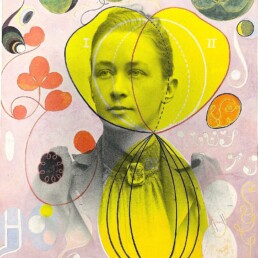
52: Hilma af Klint • Painting the Unseen • Part 1: Life & Death & Art
January 1906: a Swedish artist named Hilma af Klint begins to receive uncanny requests from spiritual beings. These are figures that speak to her during séances and trancelike states. With names like Ananda, Amaliel, and Gregor.
They want something from Hilma—they want her to paint. And they instruct her what to paint. How large and in what medium. And eventually, even how these paintings should be shared with the public: displayed in a vast temple space built in the form of a spiral that climbs high and opens into an observatory at its peak. The purpose of which is for no less than the spiritual advancement of humanity. It’s an ambitious work.
And over the course of 9 years, Hilma takes these commissions from the spirit world very seriously. So seriously, in fact, that at first she doesn’t tell anyone about them except her closest friends. There is a sense that she is on an important mission for humankind, to paint the unseen. She names this series of artworks: Paintings for the Temple.
In 1915, after 9 years, Hilma completes the series, with a whopping 193 paintings.
But Hilma realizes that the world is not yet ready for the challenging nature of these works—they are abstract paintings before abstraction had a name—Hilma completed many of these even years before the artist Wassily Kandisky staked his claim on abstraction.
Not to mention the fact that these were painted by a woman who violates all the norms of her time. And so, Hilma designates these paintings with a symbol: +x. And instructs whoever inherits her 1,500 artworks to wait 20 years after her death before sharing them with the public.
In effect, she launches herself into the future. Guaranteeing the safety of her art and the reception it deserves. Her seminal work from 1915, The Paintings for the Temple, will not truly be appreciated by the public until a century later. When the Guggenheim dedicates its entire museum to Hilma in their monumental 2019 exhibit: Hilma af Klint: Paintings for the Future.
What makes Hilma’s artwork so groundbreaking? Did she really create her art with the aid of higher beings? And why did it take a century for the art world to catchup with her vision and finally recognize her genius? Join me as we discover the answers to all of that and so-much-more.
This is the beginning of my series about the Swedish artist and mystic, Hilma af Klint. It’s a story that has everything: secret societies, séances, occult traditions, love, communication with higher entities, groundbreaking innovations in art, and deep existential questions about life itself. All of this revolving around a central figure who is an undeniable creative genius—Hilma af Klint.
Welcome to Creative Codex, I am your host, MJDorian.
This is Hilma af Klint • Painting the Unseen • Part 1: Life & Death & Art
Let’s begin.
Chapter 1: Coming of Age
The story of Hilma af Klint begins in an unlikely place: a military barracks. She was born on October 26, 1862 into a military family. Three consecutive generations before her were in the Swedish Navy, starting with her great-grandfather Erik af Klint, followed by her grandfather Gustaf, and her father Victor. Each of them were military officers but also successively served in the role of director of the Military Academy Karlberg, in northwest Stockholm. The af Klints occasionally lived on the grounds of the academy. And it was here, steeped in militaristic rigor that young Hilma spent the first six years of her life.
The family name, af Klint, garnered respect in Sweden. 70 years before Hilma’s birth, her great-grandfather and father fought in a war against Russia, most notably the Battle of Vyborg Bay—still considered one of the largest naval battles in history. As a sign of gratitude to the family, King Gustav III elevated the Klints to the status of nobility. From that moment onward they would be known as the af Klint family, the term af in Swedish being a preposition similar to von in German, denoting nobility status.
Even Hilma’s brother, Gustaf—who was older by four years—followed in his father’s footsteps and joined the navy. It’s a near certainty that if Hilma had been born a boy, she would’ve also been ushered into military life. She was saved from this fate due to her gender—a factor which, in the 1800’s played an outsized role in one’s fate, as we’ll see—but these early years at the military academy and being raised around nautical traditions would have an influence on the rest of her life. It would bleed through in her upright posture, her tendency to draw maps when traveling, and even cartographic symbols in her artworks.
Hilma’s grandfather designed the famous book Naval Charts of the Baltic Sea and her uncle created the Marine Navigation Table. One can even make a connection between this family interest in mapping the physical world and the diagrams Hilma would paint fifty years later. Watercolor paintings of plants and flowers with small meticulously painted squares beside them, depicting an unseen spiritual aspect of the plant.
When Hilma was six years old, her family—including her parents, older sister and brother—moved out of the military barracks, and into an apartment in central Stockholm on a modern street named Norrtullsgatan. After she finished elementary school, young Hilma entered the Royal Normal School for Girls with her sister, Ida. It was around this time that their mother, Mathilda gave birth to Hermina—the new baby of the family.
Although Hilma attended secondary school, this was not the case for all girls her age. In the 1800’s, boys and girls were not yet granted equal access to education. And it is more a testament to her family’s ample means that Hilma’s education continued—while boy’s educations were free, parents had to pay to send their girls to school. Sweden was not unique in this point of view in the Western world.
In this regard, Hilma grew up in a liberal family, both her parents saw the value of letting their girls continue their education—including classes in the natural sciences and mathematics. But all that in mind, it still did not mean Hilma was an enthusiastic student, recounting her school years she later wrote: “I can’t remember much more than that school caused me grief.”
Spoken like a true artist. If art classes had been offered at the time, perhaps that would have been a saving grace of academia.
When it came to art, Hilma showed herself to be a star pupil. This is evidenced by the incredible skill and craft displayed in her figure drawing studies, landscapes, and representational paintings. When Hilma was later accepted into the Royal Academy of Fine Arts in Stockholm, she was regularly in nude figure drawing classes. One of her drawings from this class—of a naked man with his legs crossed looking upward with his hands clasped over his knee—shows Hilma’s advanced artist’s eye and her ability to excel at classical forms of art.
I’ve taken these kinds of figure drawing classes before, and what Hilma achieves in this illustration is not easy. It’s not the quality of a student, it’s on par with the quality of an instructor.
She exhibits subtlety of form in the chest and collarbone, gradation of light and shadow around the arms and legs, lightness of touch in her contours on the muscles of the shoulder and foot. Every aspect of the proportion of the human anatomy is correct. I say this because I want it to be known: let there be no doubt that Hilma was skilled and very well trained in classical art styles.
Now why is this important to establish?
This is to dissuade any critical voices who always seem to chime in concerning artists who make abstract art and say “Well, clearly she turned to abstract art because she couldn’t cut it at classical painting.” Whatever style her work takes in later years is entirely based on creative vision and not lack of craft.
Now, we’ve gotten ahead of ourselves. Back to where we left off.
When Hilma completed school at the age of seventeen she expressed an interest in continuing her education in fine art. She began her first classes in 1879 at Stockholm’s Technical School. In addition, she took painting classes at a private school. It was an art studio run by the artist Kerstin Cardon, and it was intended only for female painters. In a world of art schools where only men were allowed to teach, Cardon was a pioneer. And she modeled her school after those she attended in Paris.
There is no doubt that Cardon was an early role model for Hilma. Here was a woman who was not only an accomplished artist and teacher with her own studio, but she also received commissions for portraits from aristocrats, military officers, and the royal family—including three portraits of the King. Kerstin Cardon was dependent on only herself in a society where women did not even have the right to vote.
Such women were rare, but on the occasion when paths crossed, young Hilma felt immediately drawn to them. She was seventeen and out of school, there is no doubt she was imagining what her future might look like. Could she become self sufficient? Would she be a teacher, a painter, or something else?
It was around this time that her path also crossed with a second influence: artist and photographer Bertha Valerius. Her path was similar to Cardon’s—receiving formal training at the Royal Academy, studying in Paris, and painting portraits of royalty. But one key distinction between the two of them made all the difference to Hilma: Valerius was also a spirit medium.
In the book Hilma af Klint: A Biography, the author, Julia Voss writes:
“She was probably among the first mentors to help Hilma navigate the realm of the spirits.
The notebook documents a séance on July 26, 1879, when Valerius channeled a voice for the first time. The spirit’s name was Ulla. She got straight to the point, paving the way for all the voices that would speak in later sessions. She criticized the state church and pointed to ‘falsehoods in the theological doctrine.’ According to Ulla, it wasn’t right to consider the Bible the sole basis of faith.
Jesus was sent by God, as was well-known, ‘and returned to him when his mission was completed.’ This made her happy, she explained, and those listening understood her meaning. (Finding biblical examples that supported the possibility of communication with the dead was almost a sport in those circles.) Heaven was open, and not a one-way street. Jesus could leave and return. Why should he be the only one, or the last to do so?”
This was a radically new way of exploring spirituality. It implied that not only were there imperfections in orthodox religion but also that the dead could be spoken to directly through spirit mediums and séances.
We should take a moment here to clarify what is a spirit medium? And what are séances?
A spirit medium is a person who contacts the spirits of the deceased with the intended purpose to have a dialogue with them. In the 1800’s this was most commonly done through séances, in which a group of people come together around a circular table, hold hands, and perform various rituals with the intended purpose of channeling a spirit through a spirit medium in attendance.
This was a practice which arose out of spiritualism—a movement that sprang up in popular Western culture in the mid-1800’s. The crux of spiritualism is the idea that the consciousness of the deceased survives after death and can be contacted and spoken to.
Since it first appeared in the 1800’s, this idea has gotten its hooks into Western culture and never really gone away. As evidenced by the various daytime TV spirit mediums who make their careers off cold-reading the grief of audience members. We can also see its influence in the popular Ouija board, that even kids play with.
It’s natural to have some knee-jerk skepticism about this stuff. There most definitely were charlatans around in the late 1800’s—just as there are now— profiting off of the popularity of spiritualism, but we shouldn’t completely write it off. Because there were also countless groups of people gathering for séances without any monetary incentive, doing sessions in private, and without any desire for publicity. Only keeping a journal of the session, what was said, what was seen, etc. So something significant and meaningful was taking place in these experiences.
And ultimately, the thing that ruins these movements which always start from a genuine interest in something esoteric is the conmen and charlatans. After you see a dozen newspaper worthy scandals, a trend like this starts to die out, regardless of the real benefits it may have been providing to individuals.
The fact that people from Sweden to Paris to the United States were all trying to channel spirits through the same methods and in the same time period is pretty remarkable. And again, this indicates there is more happening than meets the eye. For one thing, leaving metaphysics aside, there is a socio-political element involved.
The author, Mitch Horowitz, writes this on the subject in his book Modern Occultism. He writes:
“Meanwhile, as Americans organized séances and consorted with mediums, it grew apparent that most spirit mediums were women. With Spiritualism’s development into a national movement with its own lecture clubs, newspapers, and eventually churches, there appeared, for the first time in modern life, a framework in which women could function as religious leaders, of a certain sort. Spiritualism, already developing a progressive politics, attracted a wide range of women who desired a voice in civic culture.
In July 1848, about six months after Kate and Margaret Fox introduced the Rochester rappings, the gavel fell on the watershed Seneca Falls Convention for women’s rights, about forty miles east of the Fox home down Route 20, the ‘psychic highway’. Indeed, for about two generations in the nineteenth century, you could not find a suffragist activist who had not spent some time at the séance table or a séance habitue who was not active in or at least sympathetic toward suffragism…
In 1853, suffragist Mary Fenn Love convened the first New York State Women’s Rights Convention. She announced ‘Spiritualism has inaugurated the era of woman’…”
In the broader society of the 1800’s, women were repressed and their options limited—just as they had been for centuries prior. But now things were reaching a boiling point. I think part of that was basic education, it’s hard to repress someone who is well educated. It’s why one of the first things authoritarian regimes do to hold their power is control and degrade the education systems of their country. Banning books is about control—limiting the exposure to new ideas. You should only think what those in power want you to think.
This wasn’t only about the right to vote, this was about the right to own property, own businesses, work higher paying jobs, to be entitled to the same education that men were, and to not be treated as lesser than. It was about agency. And it was going to require an entire shift in the cultural norms of the Western world. This is no small feat.
And so around this time you see the first seeds of the suffragist movement starting. As Mitch Horowitz mentions, the Seneca Falls Convention occurs in the US in 1848. And in Sweden, 36 years later, the first motion is put forward in Swedish parliament for giving women the right to vote. It would take a few more decades of vigilance before the right was ratified into law, but it is around this time that Hilma is attending séances and engaging with the spiritualist movement. This is the sociopolitical environment within which she is coming of age.
Hilma is seventeen years old. And in spiritualism, women had agency. Not only did they arrange and attend the séances, but they were also largely the spirit mediums. It was thought that women had a closer connection to the spirit world. Add to that, it became a way for women to gather together who happened to share views on women’s rights. So no, we shouldn’t just write off the potential positive effects of a movement like spiritualism.
The lasting influence of women like Bertha Valerius on Hilma’s personal development cannot be overstated. And there must have been some mutual affection in their relationship, because Valerius gave Hilma the black book within which the notes of the séance sessions were written. And it is in that black book which we find a very compelling entry from another session. The author, Julia Voss, mentions it in her Hilma af Klint biography, she writes:
“…in February 1879, an entry appears that deals neither with the past nor with the dead characters who surfaced from it, but rather with the future. A spirit named Charles spoke of a new epoch in art. The time was approaching, he said, and it would involve men and women artists equally.
Charles said: ‘The priests and the priestesses of art need no materials other than the fine waves that surround them, which resemble the air around them. To create works of genius they must only develop the strength that lies in the pure will… to be beautiful and free of all the defects that one finds in the work of earthly artists. To paint is to let the light shine that the artist forms in his own spirit.’
To make this prophecy more vivid, Charles turned to a musical analogy. What had already been achieved in art, he said, resembled the chirping of insects. What was to come would sound like organ music in comparison. This raised an obvious question. Who would play the organ? Who would be the new geniuses?”
We can only imagine what effect such a statement must have had on young Hilma. It was perhaps a confirmation of some force inside of her that she already felt bubbling to the surface. Something which had not yet been given form. Valerius gave Hilma this journal of the séance sessions, and she held onto it for the rest of her life.
Since Bertha Valerius was an artist in her own right, she had a vested interest in the progress of art. This séance was not the first time the topic came up. A few years earlier, Valerius published a book titled Meddelanden från den osynliga—Messages from the Invisible. She kept her authorship remains anonymous, only the initials B.V. are credited, but those in spiritualist circles knew.
In the book, Valerius writes about her accounts as a “writing medium” and the messages she received. Of note are the messages that predict a future where artists would wield “great power” and “revive the sacred fire on the altar of art.” She wrote “The temple of art will then no longer be desecrated by sensual images, since music and painting will harmoniously reproduce the higher pure inspiration…completely different expressions will emerge from the practitioners of art.”
It rings with the tone of a prophecy. This was published in 1886—by the turn of the century the prophecy would be fulfilled. There’s no doubt the words bolstered Hilma’s own creative vision. We know she read the book because it appears in one of her many notebooks, she sewed it permanently into the pages.
This art prophecy did not speak solely about one individual. It spoke about a movement.
There is a tremendous allure to the feeling that you are part of something: a movement, a tradition, a revolution. The spirit which Valerius channeled spoke of a new epoch of art in which both men and women would play a major role—calling them priests and priestesses. And through which, an art would emerge which was elevated in purpose; free from the defects of ‘earthly artists’. This would be a new spiritual art. Hilma was only seventeen at this time, but a seed had been planted, and in the years to come its roots would begin to stir.
INTERMISSION
And now it’s time for a brief intermission… ad break for Magic Mind. (Visit magicmind.com/codexmf and use code: CODEX60 for 60% off.)
Chapter Two: The Five
The popularity of spiritualism during the 1800’s was not surprising. The idea that you could still speak to your loved ones after they passed brought some solace to living with grief. In the 1800’s, death was a very real and present force of daily life. For one, antibiotics wouldn’t be discovered until 1928—when Alexander Fleming observed mold in a petri dish inhibiting the growth of bacteria, which led to the discovery of penicillin. Most of the passing infections and diseases we complain through but survive nowadays, were potentially fatal for most of human history.
To put this into perspective, in the 1800’s, based on the statistics of child mortality rates, 30 – 40 percent of children did not make it to the age of five. Can you imagine that? Roughly one in three children would die before they reached five years old. If you were living in the 1800’s, there is a high likelihood that some of your closest friends or siblings would not be alive.
For example, in the year 1800 in Sweden, the average child mortality rate was 381 deaths per 1,000 births. In the USA, it was even worse: 462 deaths per 1,000 births. Almost half.
As medical practices gradually improved so did the child mortality rate. By 1860, around the year of Hilma’s birth, the rate in Sweden was 246 deaths per 1,000 births. That’s 1 in five children—still a frightening number. Compare that to today, which in Sweden the number has dropped to 2 deaths per 1,000 births and 7 per 1,000 in the US.
Is modern medicine perfect? No. Is it the best we’ve ever had? Absolutely.
And so, with this context in mind, we can see how spiritualism’s practice of contacting spirits of the dearly departed brought something tangible to those living with grief—solace.
The af Klint family lost two children—their first and their last. Their first child, Anna, died before reaching the age of two. And their last child, Hermina, who was born when Hilma was roughly eight years old, died on October 17, 1880. Hermina was ten years old when she died. It’s not clear how she died, the author Julia Voss states that the most likely cause is pneumonia. But what is clear is how the tragedy must have affected the family.
In the 1800’s, it was unfortunately common for a child to have life threatening medical struggles in the first five years. But for a child to pass away at the age of ten, when their life is really taking shape…I can’t even imagine. Hermina died on October 17th, 9 days before Hilma’s 18th birthday. We can assume there was no celebrating during that dark month—the entire household was in mourning.
There are few details about Hermina or indications of how close Hilma may have been to her. Except for this one: an inscription which Hilma wrote in December 1934, accompanying a series of her watercolors she writes: “Made in remembrance of her who was dear to you.” She later added the note “Refers to the death of sister 1880, Hermine.”
Fifty years later, Hilma was still dedicating art to the memory of her 10 year old sister. Perhaps that’s all the indication we need for the depth of feeling she still had for her.
The author, Julia Voss, writes this in her biography of Hilma:
“From her earliest séances, af Klint understood that detecting the invisible powers of the universe was not just the task of scientists. Artists, she knew, had capacities, elevated senses, that would allow them to apprehend phenomena that eluded other people—rays, waves, and vibrations. She shared this view with other unusual artists of the century, including Georgiana Houghton, who had also lost a sister, and Edvard Munch, the Norwegian painter almost exactly the same age as Hilma, whose mother and sister died when he was young.
Af Klint, Houghton, and Munch shared the experience of loss and the feeling of responsibility that grows out of it. The dead had left them in tense silence. It was for them, the living, to remain vigilant, pen and brush in hand. If there were a crack in reality that could bring them into contact with the beyond, they would find it. And if signs came from higher worlds, in whatever form, they would not fail to register them. Their losses had turned them into living seismographs.”
The year, 1896, came to be one of the most significant years of Hilma af Klint’s life. She didn’t know it yet, but the events of that year set wheels into motion which ten years later would transform her into a revolutionary artist. Gone would be any semblance of human forms which she so fervently studied and perfected in Academy classes. Gone would be the Renaissance training which dictated shadows and color theories—methods that guided all her teacher’s efforts. And gone would be any set of conventions or rules of what is or isn’t art. Hundreds of new visionary paintings awaited her.
So what caused the first rumblings of this avalanche?
In April 1896, Hilma joined a small group of likeminded women who came to be known as De Fem, or The Five. Their friendship was nearly guaranteed, as they met one another at a séance of the Edelweiss Society—a Swedish religious association, mostly attended by women, which held regular spiritualist meetings. One of the founding members of the Edelweiss Society was Bertha Valerius, one of Hilma’s mentors in mediumship.
It was at such a meeting, on Easter Sunday, April 15, 1896, that five women chose to branch off and start their own group—like a secret society within a secret society. Their names were Cornelia Cederberg, Sigrid Hedman, Mathilda Nilsson, Anna Cassel, and Hilma af Klint. They called themselves De Fem, simply The Five.
By this point Hilma was 34 years old, but she was still the youngest in the group. Mathilda Nilsson was the oldest member, at 52. Hilma was joined by her best friend, Anna Cassel, whom she met through her art studies at the Royal Academy. Anna and Hilma were truly close friends, they aligned on everything from artistic opinions, spiritual philosophies, to esoteric interests like Theosophy. And now, they had three other women to share that with.
According to Hilma’s grand-nephew, who wrote the wonderful book Hilma af Klint’s Philosophy of Life, Hilma and the members of The Five left the Edelweiss Society because it did not give them the required feedback for their spiritual development.
The Five met regularly, performing séances together, praying, sharing spiritual conversations, and making drawings of the imagery received from higher beings in their sessions. In the ten-year period of 1896 to 1906, The Five played a fundamental role in Hilma’s spiritual development. And in many ways, it trained her and prepared her for the work to come.
So what did meetings of The Five look like?
In the book Hilma af Klint’s Philosophy of Life, Johan af Klint writes:
“The meetings of The Five started with a prayer, followed by meditation and a sermon in front of an altar with a triangle and a Rosicrucian cross. The Rosicrucian Cross stands on a base of three levels, each level representing one of the three levels that The Five must pass in their cleansing process—namely the Word, the Thought and the Mystical Knowledge (the latter being symbolized by a rose wreath).
Thereafter, they continued with an analysis of a text from the New Testament. They also read aloud from Madame Helena Blavatsky’s The Secret Doctrine. A spiritual séance followed, during which they contacted with spirits and spiritual leaders. The spirits had earlier informed Hilma af Klint, that she ‘will receive a great gift, if she never forgets the power of the Highest.’”
From the start of their sessions, Sigrid Hedman served the role of medium. As she had the most prior experience in that role. Sigrid and Mathilda Nilsson were early members of the Edelweiss Society and Sigrid even published an article about mediumship in the main Spiritualism journal in Sweden. In the beginning, The Five used a device in their meetings which was commonly utilized in séances in the 1800’s to receive messages from channeled spirits, the device is called a psychograph.
This is a unique contraption invented by an American author named Hudson Tuttle, who was closely involved in the early spiritualist movement in the United States. The device consists of a central dial which is a circular piece of wood. On its side is attached a metal point. Around the perimeter of this dial are the letters of the alphabet and the numbers 0 through 9, these are printed on a decorative cardboard to which the dial is attached. In addition to the letters and numbers, the psychograph also has the words Yes, No, Goodbye, and Don’t Know.
In essence, this was the first Ouija Board, but instead of moving a planchette around a board, the participants place both their hands on the dial and observe the movements and pauses of the pointer. Whatever letters or numbers it pauses on are recorded by the member who is tasked with transcribing the session notes. Since Hilma was the youngest of the group, this may have been her first task in the sessions.
The inventor, Hudson Tuttle, wrote this explanation about the Psychograph in the December 1887 edition of the Religio-Philosophical Journal:
“The instrument is not a mere machine that will grind out communications; it is only a delicate means. It must be used intelligently. The sitter should sit with reverent seriousness, and undivided desire, and at fixed times, and not become discouraged if many sittings pass without results. There is scarcely a family in which at least one sensitive or mediumistic person may not be found, and the discovery of such sensitive members and their development, is the desirable office of the Psychograph.”
In an ad for the device, Tuttle mentions it is designed to achieve “intelligible communications” from “discarnate entities”.
The psychograph was the first method which The Five used to communicate with higher beings. They took diligent notes of each session, recording the name of the spirit present and every statement exchanged in the dialogue. Soon after the inception of the group and their unique séance methods, they channeled spiritual leaders who promised to aid the members of The Five with spiritual guidance. This concept of spiritual leaders has correlates in the popular framework of Madame Blavatsky, who was the founder of Theosophy—a movement which all of the women in The Five studied closely and which made up part of their philosophical discussions.
In Blavatsky’s writings she spoke of instructions coming to her and her followers from the “ascended masters”, she referred to them by the Indian term, Mahatmas. A term later adapted by Aleister Crowley as the High Masters in his system of occult magick called Thelema. But The Five weren’t interested in occult magick, rather they were after spiritual growth and mystical experiences.
There were five spirits The Five would consistently channel, they were named Gregor, Georg, Clemens, Ananda, and Amaliel. Each with their own histories of their former lives on earth.
The psychograph was an effective tool for dictating messages from the spirits, which the group would then meditate on, but it had its drawbacks too: for one, it took a long time for a message to be relayed through it one letter at a time. Add to that, it did nothing to capture the imagery which the medium of the group would see during the channeling session. The artists of the group, namely Anna Cassel and Hilma, were no doubt excited by the prospect of introducing drawing into their mediumistic methods.
And so the sessions of The Five evolved to include both written messages and imagery from the High Ones. The process for achieving the imagery can best be understood as a type of automatic drawing. The member serving in the role of drawing medium would have a pencil in one hand and a large format notebook opened to a blank page. They would first have to clear their mind, as Johan af Klint describes—in a cleansing process related to the steps below the rosey cross on their altar, the steps representing “the Word, the Thought, and the Mystical Knowledge.”
The scribbles of this new method begin in October 1896, and as time goes on, the drawings increase in sophistication. Growing more deliberate and complex.
What do the drawings look like?
During my research, I began to feel this was an integral question. Because something transpires in Hilma from 1896 to 1906 which turns her into a visionary. To understand the nonrepresentational masterpieces to come, we have to trace the thread further back to these spiritual events and the drawings of The Five.
I scoured the internet for resources in this regard. And to my surprise, I found a relatively unknown printing of a facsimile edition of The Five’s Sketchbooks. Why do I say this book is unknown? Well, it was released three years ago and still has no customer reviews on popular online book selling sites. So I ordered it with great anticipation.
And when it arrived, it did not disappoint. The book is called Hilma af Klint and The Five’s Sketchbooks. It is a facsimile edition, which means the drawings are full page printings and you get the illusion of the texture of the page and the well used cover of each sketchbook. The only downside is that it is only three of the thirteen full sketchbooks. But for our research purposes it is invaluable.
The three chosen sketchbooks are from the beginning, middle, and end of The Five’s activity. They are labeled No. S2, S6 and S13. They cover the date ranges from October 5th 1896 to January 1906.
The moment they arrived, I began to study these sketchbooks earnestly.
The question was: what can these drawings tell us about the inner workings of The Five’s séances? Sessions which were conducted in utmost secrecy and whose purpose was the spiritual progress of each member present. These drawings were not meant for public display and the members of The Five would likely not even call them art. They were simply transcribing what was seen by the medium from the spirit world—much like an artist might sketch a landscape of a new city they were visiting.
One of the first drawings, dated October 5th, 1896 shows a variety of oddly familiar forms within an unfamiliar landscape. There is a triangular slope that climbs from the bottom of the page to the right side, the form stretches to a point as if being pulled, at its tip you see what can only be described as a star-flower, with the hint of flames emanating from it. Within this large sloping mass are two subdivided sections, one of which has strange looking branches that resemble the branches of a bush with leaves. And the other subdivision has circular blobs or holes that are filled in with the pencil to look black.
On the middle-left of the page we see a conical structure which opens up into an alien looking flower with pods on the end of its five stamen. And on the lower left corner there is a carefully illustrated eye with a widely dilated pupil inside of a bubble, below which is a chalice, reminiscent of the holy grail or the chalice used in Holy Communions, this is also in a bubble.
Altogether this drawing gives the impression of a sketch for a surrealist painting. Mind you, this is over twenty years before the formal start of Surrealism, a tradition within which the act of automatic drawing was also practiced and encouraged. But unlike automatic drawing, I suspect these sketches are an attempt to capture what was seen by the medium while in a deep state of meditation and not to simply draw something without conscious intent.
This distinction is important. Because to imply that these drawings were done automatically, meaning that there was no conscious intent, removes the overt spiritual nature of The Five’s work. And that would result in a gross misrepresentation. The impression that these sketches give me is that they are transcribing something seen with the mind’s eye or with the eye of the spirit.
This specific sketch we are talking about has no identifying markers, except for the date: October 5th, 1896. There is no signature at the bottom or back of the page. And it’s unclear which of the five women created it. Is the image a combination of symbols seen during a trance state, arranged together after-the-fact? Or is the entire image a representation of some spiritual landscape witnessed by the one doing the seeing?
These questions abound while flipping through the many pages of The Five’s sketchbooks.
For example, I noticed that as early as February 1897, a curious pattern appears within the sketches: letters. But not just any letters, the letters S, M, A, H, and C. I was very perplexed when I first noticed this. I started looking through all the drawings in an attempt to find the logic of the letters. They appear in various contexts, sometimes interspersed amongst the abstract forms of the drawing and other times positioned deliberately within what look like flower petals.
This is a recurring feature of these sketches: flowerlike forms. Objects that take the shape of flowers but aren’t quite flowers. This is also a signature feature of Hilma’s later paintings. Such as painting no.7 in the series called The Ten Largest. In that painting, the central yellow form gives the impression of overlapping flower petals.
In one of the drawings of The Five’s sketchbooks, marked Sept. 20th 1898, one of these flower forms appears in the shape of a cross with four petals, which are only implied through disconnected dots. Within each petal is contained those same letters again: S, M, A, H and the center of the flower-cross contains a C. This same pattern appears later in January 26th 1904, but the petals are much more pronounced, and filled in with four levels of light to dark sections. The letters appear as before S, H, A, M, and C at the center.
I still couldn’t figure out what the letters meant, so I flipped through all the sketches…until it hit me…at the base of one of the drawings was what appeared to be a signature, it was the letters S. M. A. H. C.
Of course! It wasn’t some secret code, it was their initials! Sigrid, Mathilda, Anna, Hilma, and Cornelia. This immediately unlocked one of the mysteries of the séance sketches. This group of capital letters always refers to the members of The Five.
We have to then ask: during these sessions, did the position of different letters within and around the abstract forms have different meanings or advice for the members? Say, if a letter was on a flower petal versus outside of it or in the center, would the group then interpret a different message? When their initials first appear in the flower cross petals in 1898, the petals are only implied with dashes, but in 1904, the petals are bold and filled in with four levels of gradation. Does this represent the successful spiritual growth of the members of the course of six years of regular meetings?
This way of analyzing the sketches adds another potential layer to the meanings The Five may have obtained from these images, which they channeled from higher beings.
I turned again to the signatures, and compared them across multiple drawings across the years. And again found myself at a roadblock. The signatures were oddly inconsistent. At times they did appear with the order of S. M. A. H. C. But at other times there was no signature, or they were labeled D.F. Still others were labeled with letters missing or out of order.
After some time I realized that D.F. simply stood for De Fem, the Swedish way of saying The Five. But why did other drawings only feature four letters rather than five or in different orders entirely?
I began to suspect the signature of initials was also a way of taking attendance for future posterity. If one of the women was absent from that session, they would record only four of their initials. Such as on the drawing for July 11th 1898 the signature reads H. C. S. M. (Hilma, Cornelia, Sigrid, Mathilda) in which case, Anna was absent.
Which calls to mind another question: if the order of the letters is different, does it imply that the one serving as drawing medium is written first in the signature? Does the July 11th, 1898 signature indicate that Hilma was starting to do the medium-drawings as the signature begins with H? This would mean that within two years of starting their sessions, The Five was giving Hilma the opportunity to channel imagery.
That sketch from July 11th shows five figures approaching an island on the bow of a boat, then the five figures on a small island standing before a towering cross with what appears to be a crown or flames at its peak, and to the right, the five figures leaving in a boat with a black cross on its stern. Directly above these scenes we see the letters M S H A C floating in the sky.
In this case, I suspect Hilma or whoever was serving as the drawing medium was not recording abstract forms from the spirit or thought realm, but rather a vision. It showed the progression of a scene, from the journey in a boat, to arriving at an island, and leaving. So again, we are not witnessing automatic drawing, instead we are seeing someone transcribing a vision which was seen while in a deep trancelike state or meditation.
As the years progress, the instances where H. is written as the first letter in the signature become more frequent. If our present theory holds true, it means Hilma is more frequently serving the role of drawing medium in the sessions. This creates a direct line of influence from the sketches to her paintings.
For example, in the sketch from August 24th, 1897, there is shown a tiered pyramid structure with a large eye at its peak, the eye radiates light rays downward. This sketch is signed with only three members: Sigrid, Mathilda, and Cornelia. Then in January 14th, 1904, we again see what looks like a vast pyramid stricture, it seems to radiate with energy. There are four black dots at the center connecting down the levels into other dots and some subterranean layers. The peak of the pyramid is an enormous star with a black hole at its center, it radiates light powerfully in all directions. The signature is S.H.A.C.
Both of these pyramid structures have very strong resemblances to one of Hilma’s most famous later paintings titled Altarpiece No.1. Which shows a vast pyramid of remarkable colors, whose peak is a deep black triangle with a golden dot at its center. Behind this triangle is an enormous golden sun that sends out rays in all directions.
Did all the members of The Five see such a pyramid in their visions? Thus confirming its importance to Hilma as an altarpiece.
The dates of the two sketches just mentioned indicate they were drawn seven years apart, but Sigrid appears as the first name in both, and Hilma is absent from the first drawing’s signature.
Whatever the case may be, it’s becoming clear that the procedures of The Five—those being their cleansing rituals, prayers, meditations, and séances—were producing reliably consistent symbols and forms across the span of years, which they viewed in visionary states.
Were these forms viewed only with the mind’s eye or with the eye of spirit? Were they channeled from higher entities—angels, archetypes, ascended masters? Or was their origin from some repository of stored human thought forms such as the collective unconscious or the astral plane?
In entries from Hilma’s personal notebooks, dating 1918, we find this statement:
“My mission is to explore the Astral life…”
I’m certain that to the skeptic’s mind, we are approaching the territory of speculative fiction. But you cannot deny the facts: we have before us an example of a remarkable scientific experiment. Conducted countless times by the same five people over the course of ten years. The results of which are thoroughly recorded in their written statements and drawings.
But The Five didn’t see this as a simple experiment. Their aim was always clear—to make contact with other planes of reality to aid their spiritual growth. It went on like this for years.
Until a fateful meeting on April 12th, 1904, when Anna Cassel channeled something which would tear their fellowship apart. It was a message, like the countless messages they had received from spirits using the psychograph, but this one was directed at Hilma, and a great task that lay before her. The notebook entry from that session reads:
“Ananda also prays for you, Hilma. You should rest for days, quiet and still. Look toward images, old ones, images that wait for you. Just have patience, then you will be guided, calmly and surely, to the goal that lies before you.”
Mathilda, Sigrid, and Cornelia did not find anything unusual about this communication initially—the spirits did address specific members from time-to-time. But the implications of this message immediately caught Hilma and Anna’s attention.
“Look toward images…old ones…images that wait for you…have patience…you will be guided to the goal that lies before you.”
To Hilma af Klint and Anna Cassel, both of whom were artists trained at the Royal Academy, the spirit’s message was clear as day: artworks. The Great Work they had been engaged with for all of these years would soon be shifting to images which “await”.
The author, Julia Voss, gives us more details in her Hilma af Klint biography, stating:
“For Cassle and af Klint it marked the beginning of something new. The message seemed to announce an additional channel through which communications would come to them directly and without distortion. Almost immediately they saw the need to record the communications in their own notebooks, separate from The Five.
Hilma had actually been doing this since 1901, and now she had a comrade in arms. The notes they made are rendered in a new style: they are neither vague nor noncommittal. They do not hesitate or defer; the messages are concrete and meant to lead to actions. The main purpose of the séances, which had been difficult to pinpoint, suddenly became clear. It was not just a matter of developing one’s own spiritual capacities and slowly approaching a higher truth. Now there was a goal, a purpose, a mission. And they, Anna and Hilma, would accept it.”
To the other three members of The Five, this new enthusiasm seemed misguided. Hilma and Anna thought they were finally receiving clear instructions for spiritual artworks but it was Sigrid, Mathilda, and Cornelia’s opinion that they were “putting words they wanted to hear” in the mouths of the High Ones. Hilma and Anna believed the new artworks could be completed as a collaboration done by the entire group—but the others disagreed. This proved to be an irreconcilable difference in the spiritual direction of The Five. And they formally disbanded after ten years in 1906.
It was the end of a life changing spiritual partnership.
But Hilma’s soul was already churning with the fires of creation. There was nothing to slow her down now, the new work ahead was waiting. And although the fellowship of The Five had been broken her line of contact with the spirit guides remained crystal clear. The purpose of the work was shifting, and instead of individual spiritual progress the focus now was the spiritual evolution of all humanity.
At forty-four years old, she picked up her brushes and began to paint the unseen.
Hilma stated:
“I am so small, I am so insignificant but the force that flows through me is so powerful that I must go forward.”
“The experiments I have undertaken…will astound humanity.”
On the next Creative Codex…
Hilma af Klint accepts a commission from her spirit guides. The aim is to paint a collection of works which will one day be shown in a spiral Temple for the spiritual benefit of all humanity. What does her process look like? What do the Paintings for the Temple reveal to us about Hilma’s spiritual philosophy?
We’ll also explore the occult traditions which inspired Hilma. And we will speak with the preeminent Hilma af Klint scholar, Julia Voss, author of the seminal biography of Hilma. And ask her to help us to truly understand this remarkable woman. [Cue sample from our interview.]
All this and more on Part 2 of Hilma af Klint • Painting the Unseen.
I’ll see you then.
PATREON

Become a patron of the show, and gain access to all the exclusive Creativity Tip episodes, as well as episode exclusives. Just click the button or head over to: https://www.patreon.com/mjdorian
Wanna buy me a coffee?
This show runs on Arabica beans. You can buy me my next cup or drop me a tip on the Creative Codex Venmo Page: https://venmo.com/code?user_id=3235189073379328069&created=1629912019.203193&printed=1

VENMO