EPISODE TRANSCRIPTS
PART 3: FROM STRENGTH to TEMPERANCE
Tarot Exegesis • Part 3: From Strength to Temperance
Welcome to Creative Codex, I am your host, MJDorian. This is the third offering in my Tarot Exegesis series. These episodes serve as supplemental material to the main Tarot series.
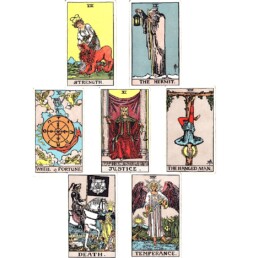
On this episode we will continue our exploration of the symbolism of the Major Arcana with cards 8 through 14: Strength, The Hermit, The Wheel of Fortune, Justice, The Hanged Man, Death, and Temperance.
The traditional interpretations of the card symbolism come from several resources including Seventy Eight Degrees of Wisdom by Rachel Pollack and The Way of Tarot by Alejandro Jodorowsky.
Throughout this investigation we are approaching the Major Arcana through the framework of three rows of seven commonly used by occultists. The first two parts of our Exegesis covered the first seven cards of the first row and The Fool card which exists in liminal space, and is free to roam in and out of the rows.
To review, when we layout the 22 cards of the Major Arcana in this way—three rows of seven with The Fool placed on the side or above—the layout of the cards represents stages of psychological growth and transformation.
The first seven cards, beginning with The Magician and ending with The Chariot, represent the concerns of the material plane. In my recent reflections on this structure I’ve come to understand these first seven cards as describing the establishment of the personality. Meaning that the archetypes and symbols of these 7 cards deal with external forces of family and society mixed with the animal impulses of our body.
For example, The Empress represents nature and sensuality—matters of the body and senses. While The Emperor represents hierarchies and social structures—matters of the material plane. The Hierophant represents formal education and dogmatic systems of thought, and The Lovers represents the development of our individuality and sexual impulses.
(Side note: each card, as mentioned in the main Tarot series, is a conflation of archetypes, and represents more than just these characteristics.)
The following 7 cards which make up row 2 of the Major Arcana, deal with the turning inward of the personality. This is the recognition by our conscious mind that there is a vast unexplored terrain within, which causes its own effects and has its own motivations. We commonly refer to this mental landscape as the unconscious. This second row then helps us to recognize these many unconscious influences and to enter into dialogue and eventually familiarity with them. This is akin to the work of psychoanalysis done with a therapist or inner work done in solitude.
Without further ado, let’s begin.
CARD VIII: STRENGTH
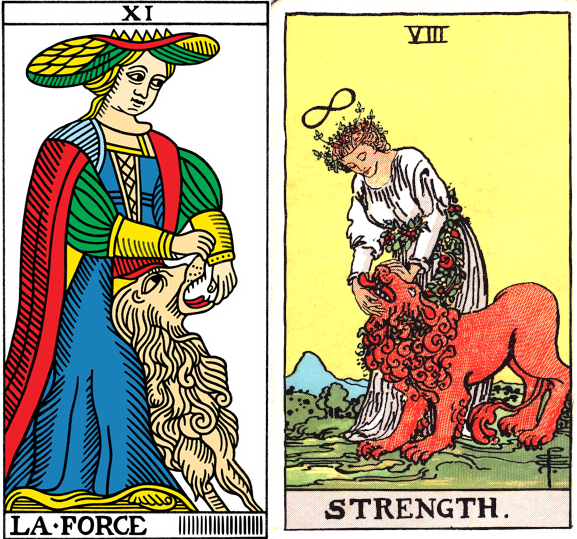
The standard imagery of the Tarot’s Strength card traces back at least 600 years. It appears as early as the Visconti-Sforza deck of the 1450’s. Strength depicts a maiden leaning over a lion, gently clasping his snout—with one hand above and one hand under his jaw. She is in full control, completely at ease. It’s unclear whether she is opening or closing his mouth, or simply caressing him—but her demeanor exhibits no fear, only a calm self assuredness.
The card is often interpreted to mean the conquering of unconscious impulses. Those strong motivations including those of the physical body toward aggression, greed, or lust. It’s appropriate then that in the Waite-Smith Tarot, this second row of seven cards begins with Strength, as we are transitioning from the first row, which was more concerned with influences of the external world on establishing our personality. From here on, we have no one to blame but ourselves.
But that does not mean the way forward needs to be one of guilt and shame. Rather, as we see in the Strength card, it is an approach of discernment and care. Alejandro Jodorowsky states that “it is she who opens the path for unconscious energies.”
The author, Rachel Pollack writes:
“…the image suggests the energy of the unconscious released and calmed, ‘tamed’ by the direction of conscious understanding…But we can also see Strength as the qualities vital for beginning the line. The search inward cannot be accomplished by the ego. We need to confront feelings and desires long hidden from our conscious thoughts…
By making Strength number 8 we set it against the Chariot, as a different kind of power, not the ego’s will, but the inner Strength to confront yourself calmly and without fear. The mysteries can be brought out because we have found the Strength to face them. The lion signifies all the feelings, fears, desires, and confusions suppressed by the ego in its attempt to control life…
The symbolism of the pictures and numbers reinforces the comparison of Strength and the Chariot. The Chariot shows a man and Strength shows a woman. Traditionally, of course, these represent rationality and emotion, aggression and surrender. Also traditionally, the Chariot’s number 7 belongs to ‘male’ magic, the number 8 to ‘female’. This symbolism arises from anatomy. The male body contains seven openings (counting the nose as one), the female eight…
Psychologically they also embody two kinds of power. Our society emphasizes the ‘masculine’ force of control; conquest, dominating the world through reason and will. But the ‘feminine’ qualities of intuition and spontaneous emotion are far from weakness. To release your deepest emotions with love and faith requires great courage as well as strength…
Those who allow the unconscious energy within themselves to emerge, guiding it with love and a faith in life, will discover that the energy is not a destructive beast but the same spirit force drawn down through the lightning rod of the Magician.”
When the Strength card comes up in Tarot readings it signifies: strength to face life’s difficulties, courage, instinctive energy, sexual matters, one’s animal nature, and self discipline.
CARD VIIII: THE HERMIT
The Hermit is a timeless symbol whose roots reach further back than all of Western culture. It is the archetype of wisdom often represented as the old wise man. In non-western cultures it is represented as the yogi ascetic or the shaman. There is a facet of our psyche which understands that wisdom and balance are found in the withdrawal from the material world. That in solitude often hide the greatest insights.
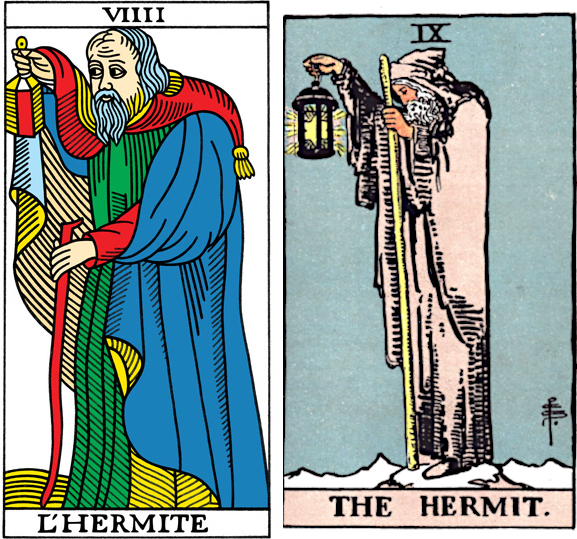
In traditional representations of The Hermit we see a bearded man with white hair carrying a lantern at his eye level and supporting himself with a staff in his opposite hand. He looks at the road ahead while standing on a mountain—or perhaps, as in the Waite-Smith version, he is looking back down at the material world from a mountaintop. From that perspective of solitude and silence, he is able to view life more objectively and more holistically—to see the larger picture it forms.
When The Hermit is seen in the context of the three row layout of personal development that the Major Arcana describes, he signifies the idea that “only by withdrawing from the outer world can we awaken the inner self.” (78 Degrees of Wisdom, Rachel Pollack)
In the Waite-Smith version, if you look closely at the light within the Hermit’s lantern, you see a six pointed star. In occult traditions this is associated with alchemical practices, as it is constructed from two overlapping triangles, one pointing upward and one pointing downward. It’s also known as the Star of David. This has many associations, including the union of masculine and feminine—the masculine being the upward active principle and the feminine being the downward receptive principle.
The overlapping triangles represent all four elements of fire, air, water, and earth. As the base of the water triangle intersects with fire to create the air triangle and the base of the fire triangle intersects with water to create the earth triangle. Furthermore the six pointed star is also a symbol for the Hermetic dictum ‘as above so below’.
In this regard, The Hermit can also be seen as a teacher or guide. There is another old dictum in occult circles also found in the Tao the Ching: “When the student is ready, the teacher appears.”
In the book, 78 Degrees of Wisdom, Rachel Pollack writes:
“The Hermit signifies a transition. Through the techniques of meditation, or psychic discipline, or analysis, we allow the hidden parts of the psyche to begin to speak to us. Later we will experience a sense of rebirth, first as an angel (the eternal part of the self, beyond the ego), then later, more deeply felt, as a free child riding forth from the garden of past experience. For now, the path belongs to the image of the wise old man, alone, supported and warmed by his stiff grey cloak of contemplation…
The Hermit’s staff suggests a wizard’s staff, and therefore the magic wand of the Magician. Whereas the Fool used the wand instinctively, the Hermit leans on it as a conscious support. It therefore symbolizes the teaching which helps open the inner awareness.”
Alejandro Jodorowsky also describes The Hermit as referring to “an inner solitude, to the secret and dark space where a spiritual transformation is prepared.”
In a reading, The Hermit represents: wisdom, solitude, a guide, old age, a pilgrimage, therapy, and a secret teacher.
CARD X: WHEEL of FORTUNE
The concept of Fortune as a metaphysical force in human affairs appears in the earliest written histories of culture. To the Greeks, she was personified as the goddess Tyche, to the Romans, Fortuna. Both figures were shown reverence for their capacity to shape the destiny of a person and even an entire city.
The Wheel of Fortune, on the other hand, is a symbol with its own history. Manuscripts showing people referring to Fortune’s wheel appear as early as the 5th century CE. But the most popular claim to the visual representation which we commonly see on Tarot cards likely traces its roots to the tales of King Arthur.
In one particular French text from the 13th century, titled La Mort le Roi Artu / The Death of King Arthur, it’s told that Arthur has a dream on the eve of his final battle in which he sees himself sitting atop the wheel of fortune and then the wheel suddenly spins, and he is brought low and destitute. This serves as a premonition to his death—a drastic change of fortune.
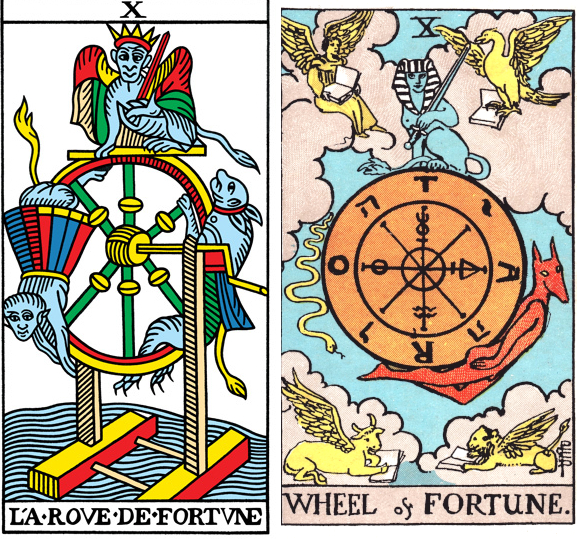
But in the Waite-Smith card, we see many more symbols married into this allegorical image. There are four creatures interspersed among the corners of the card, there is a sphinx atop the wheel, a snake on the left side of the wheel, and a jackal headed figure on the right, in addition there are symbols carved into the wheel itself.
The three figures surrounding the wheel are in reference to Egyptian gods of life, death, and resurrection. The snake is Set, the Egyptian god of darkness and death in the universe. The jackal-headed god is Anubis, a guide to souls in the afterlife and giver of new life. The sphinx that sits atop the wheel is Horus, god of resurrection. Instead of using the traditional figures of a king, nobles, and a beggar, Waite and Smith chose more spiritually infused symbolism depicting the cycle of life—birth through Anubis, death through Set, and resurrection through Horus.
Rachel Pollack gives us further insights to the card’s symbolism, regarding the four creatures in the corners of the card she writes:
“The four creatures on the corners of the card derive from the vision of Ezekiel 1:10. They appear also in Revelations 4:7.
Now, over the centuries these four figures, sometimes called the ‘guardians of heaven’ came to symbolize the four basic elements of ancient and medieval science. From the right-hand corner anti-clockwise they are fire, water, air, and earth, and these elements belong as well to Wands, Cups, Swords, and Pentacles.
Besides representing the elements the four beasts also stand for the four fixed signs of the zodiac – Leo, Scorpio, Aquarius, and Taurus. The zodiac, of course, is the Great Wheel of the visible universe. Thus both the elements and the signs signify the physical world, again seen as a mystery, and which can only be truly understood by learning the secret truths.
The other connection with the four elements comes in the four letter name of God on the Wheel’s rim. Beginning at the upper right-hand corner, and again reading anti-clockwise, the letters are,
Yod, Heh, Vav, Heh. Because this name appears in the Torah without vowels (the four letters are all consonants) it is unpronounceable; therefore God’s ‘true’ name remains a secret.
For at least two thousand years Jews and Christians have seen this name as magical. Mystics meditate on it (Abulafia’s ecstatic third level of Qabalah was reached through working with God’s name) and magicians manipulate it. For Qabalists the four letters are the very symbol of the world’s mysteries.
The process of the universe’s creation was held to have occurred in four stages, corresponding to the four letters. And of course, the letters also connect with the four elements, the Grail symbols, and the Minor Arcana.”
All of this makes for a very rich web of symbols on one card. Because of this reason, some people see the Wheel of Fortune as the center spoke of the entire Major Arcana. It is a representation of the cycle of energies taking place—birth, death, and resurrection.
In a reading, The Wheel of Fortune card is interpreted with having these qualities: a change of fortune, the beginning of a cycle or the ending of a cycle, renewal, fate, the wheel of karma, and laws of nature.
CARD XI: JUSTICE
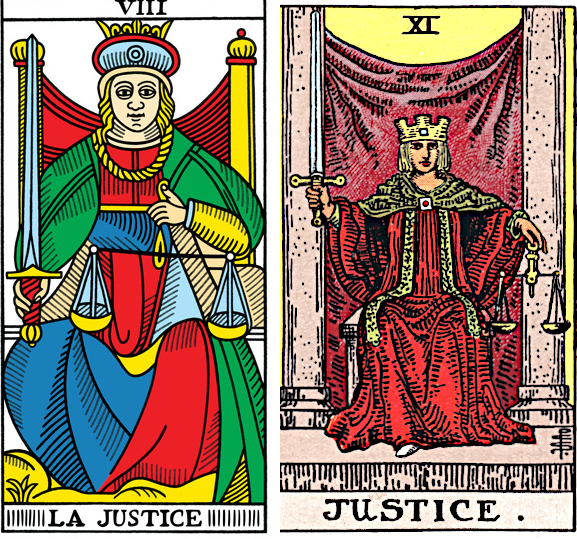
The figure of justice is commonly known in Western society as a woman with a blindfold, a sword, and a set of scales. The implication is that justice should be blind, that regardless of social class, wealth, or political power, we should all be held to the same standard. But in the Tarot, Justice is not shown with a blindfold. She appears to look at us directly, like a mirror. This is no doubt the intended effect.
This is a card that deals with discernment and honest self reflection. It is not necessarily about perfect balance but rather harmony. Jodorowsky states: “This card first and foremost involves dealing justice to ourselves, to give ourselves what we deserve.” This does not only refer to reprimands for bad behavior, but also really doing justice to ourselves, and giving ourselves what we need and deserve—taking care of ourselves. That requires discernment and honesty, and this is why Justice is without her blindfold in the Tarot.
Curiously, in the Waite-Smith, as card 11, Justice is the exact center of the Major Arcana—with 10 cards before and ten cards after. Rachel Pollack gives us further valuable insights:
[cue music]
“The imagery of trump 11 combines the Magician and the High Priestess more completely than ever before. First of all, the digits of number 11 add up to 2, but the number also signifies a higher version of 1 (as well as a lesser version of 21).
The woman seated before two pillars with a veil between them suggests the High Priestess, but her red robe, and her posture, one arm up, one arm down, implies the Magician. True action arises from self-knowledge; wisdom arises out of action. In life, as in the picture, the Magician and the High Priestess are inextricably combined, like a male and female snake twined around each other (symbol of the kundalini as well as the caduceus of Hermes), or the double helix of DNA.
The color of the veil is purple, emblem of inner wisdom; background, crown, hair, and scales are all yellow, signifying mental force. Wisdom does not arise spontaneously. We must think about
our lives if we wish to understand them. But all our thinking goes nowhere unless it develops out of a clear vision of the truth.”
In readings, the card of Justice can be interpreted as: the capacity to judge, the need for harmony in a situation, stability, discernment, to balance the scales, to forbid, to cut off destructive behavior, to act decisively for or against, and to give oneself what one deserves.
CARD XII: THE HANGED MAN
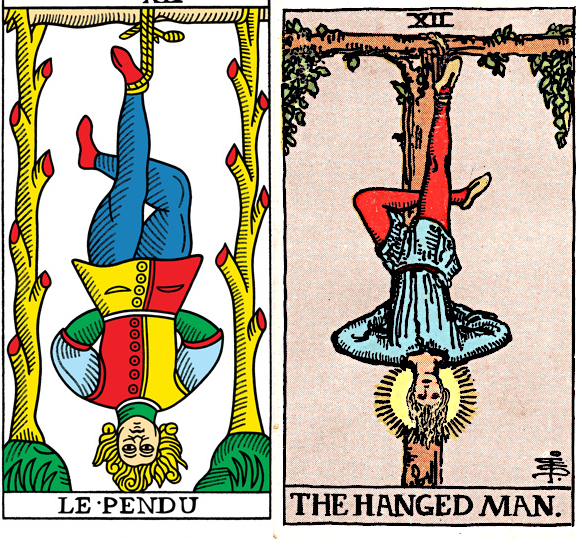
The card of The Hanged man depicts a young man hanging upside down by one of his legs, which is tied by a rope at his ankle to a wooden post. His other leg is bent at the knee and dangles behind his extended leg, forming the impression of a cross, the number 4 inverted or the astronomical symbol for Saturn.
The young man’s hands are behind his back, implying they are tied, though there is no way of confirming it. His blonde hair extends downward, further emphasizing the pull of gravity in his predicament.
On first impression of seeing this card, one imagines some scene of punishment: is it a medieval torture? But when looking at the man’s face, there is no sign of discomfort. He looks calm and even comfortable. What do we make of this? Is his predicament self imposed?
To my mind, The Hanged Man has always been associated with the story of Odin. The Norse God who valued wisdom so highly that he sacrificed one of his eyes for it. In another story, Odin hangs himself upside down from the world tree, Yggdrasil, and impales himself with his own spear. He hangs like this for nine days and nine nights, at the end of which he discovers the Runes and the secrets of their powers.
It is an ancient tale depicting the value of sacrifice, specifically self sacrifice in the service of a greater aim. And this is what I always see when looking at The Hanged Man. Alejandro Jodorowsky states that The Hanged Man is a figure in gestation, he is suspended between Heaven and Earth, waiting to be born.
In the book, The Way of Tarot, Jodorowsky states:
“We can also see, in a reversal of vision and perspectives, the upside-down status of his physical body: the intellect has been thrown down and the rational has ceased dominating behavior, while the mind makes itself receptive to profound inner wisdom, as shown by his dark-yellow hair.
Our point of view on life changes. We disconnect from a view of the world inherited from childhood, with its retinue of illusions and projections, to enter into its singular essential truth. Seen from this angle, The Hanged Man will often send us back, in the reading, to an understanding of the subject’s ties with his or her family tree.
The position of this figure, with his head at the bottom, brings to mind that of the fetus in the maternal womb, and it can prompt the Tarot reader to question the person for whom the cards are being read about the circumstances of his or her gestation and birth, or about any traumatic pregnancies the person may have had in the past.
The two trees with their lopped branches can be interpreted as two “trees” or as the maternal and paternal lines, whose neurotic situation and abusive behavior leave us hanging as impotent sacrifices, hiding behind our back—like this hanged man with his invisible hands—shameful secrets.
This card will sometimes express guilt, imaginary crimes symbolized by the twelve bleeding wounds on the trees and the punishment that is being imposed, or else the sacrifice one may be condemned to make.”
In readings, The Hanged Man, above all means sacrifice, but based on the context of his appearance he can also be interpreted to mean: immobility, the moment to act has not come, self-punishment, turn your perspective upside down, to see another point of view, a gift of oneself, and to wait.
There is one more reflection to add to this card, when viewing it from the perspective of self awareness and psychological growth. It is a quote I only stumbled on recently from Dr. Carl Jung which fits so perfectly in reflections concerning The Hanged Man. It was transcribed by Aniella Jaffé in her book Reflections: On the Life and Dreams of CG Jung. Jung states:
“People do not realize just how much they are putting at risk when they don’t accept what life presents them with, the questions and tasks that life sets them. When they resolve to spare themselves the pain and suffering, they owe to their nature.
In so doing, they refuse to pay life’s dues and for this very reason, life then often leads them astray. If we don’t accept our own destiny, a different kind of suffering takes its place: a neurosis develops, and I believe that that life which we have to live is not as bad as a neurosis.
If I have to suffer, then let it be for my reality. A neurosis is a much greater curse! In general, a neurosis is a replacement for an evasion, an unconscious desire to cheat life, to avoid something. One cannot do more than live what one really is. And we are all made up of opposites and conflicting tendencies. After much reflection, I have come to the conclusion that it is better to live what one really is and accept the difficulties that arise as a result—because avoidance is much worse.”
CARD XIII: DEATH
Death continues to be one of the most dramatic Tarot cards. It is the card used alongside The Devil in all cheesy horror movies when they want to really drive home the point that some bad stuff is about to go down. And it’s understandable why this is the case. Who wants to ask a Tarot reader about their love life and then see the Death card?
But just as it is often misused for its dramatic effect, it is also largely misunderstood. For, in most cases, it has nothing to do with literal death at all. Just as the Emperor card has nothing to do with a literal Emperor and the High Priestess card has nothing to do with priestesses. The Death card instead largely concerns dramatic transformations—ones which happen so swiftly and thoroughly that we can say a kind of death has occurred, something is gone.
But that doesn’t mean it is a negative turn, dramatic transformations can be good or bad. For instance, perhaps you hate everything about your 9-to-5 job, and you have been wanting to quit but just can’t seem to build up the courage to take that leap. You do a Tarot reading asking specifically about your career, and in the spot representing your future you have drawn the Death card.
Well, you can interpret this in a myriad of ways. First, you can say “If I remain at this job, it will be the death of me. This job will drain the color out of my life.” And in that regard, the card has brought up some truth about yourself which you have been evading. This will effectively act as the push which you needed to pack up your bags and put in your two weeks notice. It will be the death of this job and the closing of this chapter in your life. But it will in turn be a transformational moment, leading you into the new life you have excitedly been dreaming about.
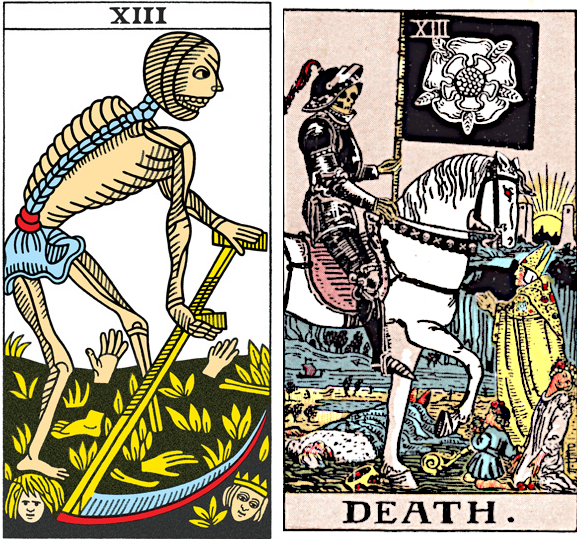
Death is a dramatic change, akin to a revolution—that is why all the traditional depictions of the Death card feature dead kings, fallen crowns, and beheaded aristocrats. Death is the great equalizer, but it also provides the opportunity for new life to spring up, and for true progress to continue its steady march forward.
Rachel Pollack, in 78 Degrees of Wisdom states:
“…the card of Death…shows us the precise moment at which we give up the old masks and allow the transformation to take place. Perhaps we can understand this better if we consider the Tarot’s parallel in psychotherapy. By force of will (Strength) the person, with the help of the therapist-guide (The Hermit), allows knowledge to emerge of who he or she really is, and what habits or fears he or she wishes to shed (Wheel and Justice).
This knowledge brings calm and a a desire to change )The Hanged Man). But then a fear sets in. ‘If I give up my behavior’, the person thinks, ‘maybe there will be nothing left. I will die.’ We live under the ego’s control for so many years we come to believe that nothing else exists. The mask is all we know.
Often people will stay stuck in therapy for years because they fear release. The nothingness of The Fool terrifies them. The fact is, they are right. The ‘I’ created out of these lifelong behaviors will indeed die. That person will cease to exist. But something else will emerge.”
In readings, the Death card can be interpreted as: profound transformation, cleansing, to eliminate what prevents us from moving forward, revolution, transmutation, harvesting, and eradication of the old to make way for the new.
CARD XIIII: TEMPERANCE
The traditional concept of Temperance comes from the four cardinal virtues, those being prudence, justice, fortitude, and temperance. Contrary to popular belief, these were not invented by the Catholic church, their roots stretch back to the philosophy of Plato, and afterwards they were further developed by Aristotle and even Marcus Aurelius.
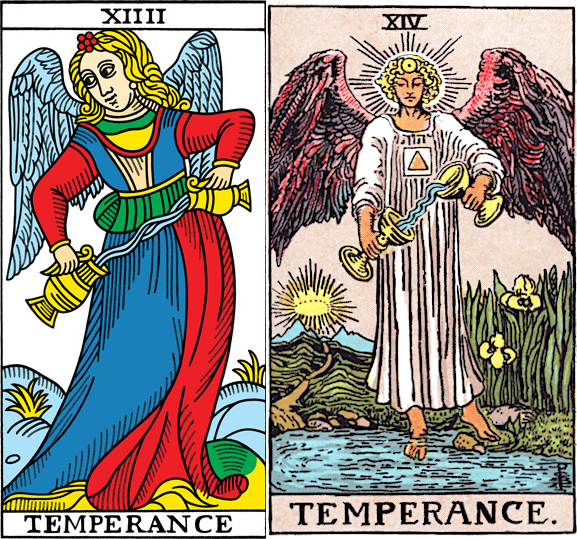
The traditional image of Temperance shows a maiden holding a pitcher in one hand and a bowl in the other, she pours the water from the pitcher from a high distance—in some versions as high as her shoulder—causing the trickle of water to cross in front of her at a diagonal and into the bowl. In the Tarot cards, Temperance is usually depicted with two identical pitchers or chalices, one of which she holds higher than the other, as the water pours between them. But there are two integral innovations added in the Tarot’s Temperance: the figure is androgynous and they have angelic wings. Details which are missing from the older depictions of Temperance in the cardinal virtues, which depict the figure as a human woman.
We see this winged aspect of the card present from as early as the Marseilles deck of 1709, and elaborated even further in the Waite-Smith of 1909—where this angelic figure, holding two chalices, is half on land and half on water—she keeps one foot on the dry land and the other foot on a body of water.
Bodies of water have long been used as symbols of the unconscious, so from our psychological interpretation we can say that the work of Temperance deals with the recognition of the influences on both the conscious and unconscious terrains—represented by the land and water respectively.
In the journey of our deepening self-awareness and development, by the end of this second row of the Major Arcana we should know to respect these two domains of our being. We should have a working relationship between the conscious and unconscious, to be able to form a bridge through which the two can negotiate a more ideal union. This is ultimately the goal of psychoanalysis—to improve the relationship between the conscious and unconscious minds.
Curiously, the Latin origin of the word temperance is temperare, which means to combine, to blend, and to control oneself.
Some food for thought.
Alejandro Jodorowsky says this of Temperance:
“Temperance ensures that energies and fluids can communicate with each other. We could
say that he/she mixes water with wine. Through his/her action there are no more opposing energies, no more opposites, but only complementarities. It is the secret of balance.
Temperance indicates the return of health, mental and emotional balance, the control of the passions not through repression but through sublimation. Temperance brings a pacifying message: ‘Find your center; your vital pendulum must avoid extremes; go by the middle way.’”
In readings Temperance can be interpreted as: moderation, balance in all things, the middle path, to circulate, spiritual healing, self-communication, guardian angel, and the transmigration of souls—reincarnation.
PATREON
Become a patron of the show, and gain access to all the exclusive Creativity Tip episodes, as well as episode exclusives. Just click the button or head over to: https://www.patreon.com/mjdorian
Wanna buy me a coffee?
This show runs on Arabica beans. You can buy me my next cup or drop me a tip on the Creative Codex Venmo Page: https://venmo.com/code?user_id=3235189073379328069&created=1629912019.203193&printed=1

VENMO